16 Joynag Road
Bakshibazar, Dhaka-1211
Bangladesh.
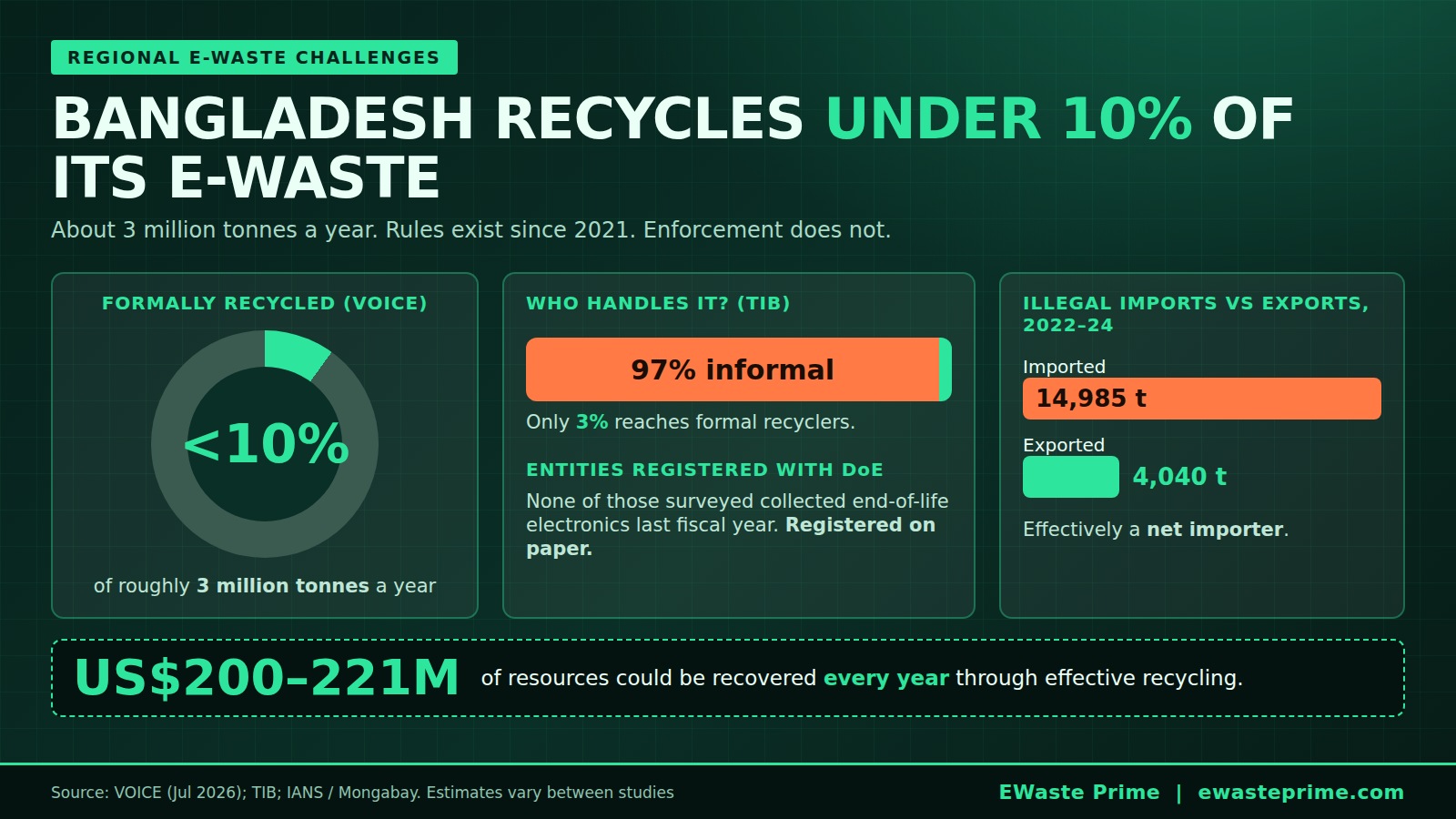
Quick answer: A July 2026 assessment by the organisation VOICE found that Bangladesh generates about 3 million tonnes of e-waste annually, with less than 10% formally recycled. Estimates vary between studies because national data is weak.
Bangladesh wrote its e-waste rules in 2021. Five years later, the gap between the rulebook and reality is the story.
VOICE reports that none of the surveyed entities registered with the Department of Environment collected end-of-life electronics in the last fiscal year. Registered on paper, absent in practice. Transparency International Bangladesh (TIB) reached a similar conclusion from another angle: 97% of e-waste is processed informally, only 3% reaches formal recyclers, and governance remains largely “on paper.” The figures differ because Bangladesh still lacks reliable national data, yet both studies point the same way.
There is an import problem too. A report cited by Mongabay says about 14,985 tonnes of e-waste were illegally imported between 2022 and 2024, against roughly 4,040 tonnes of exported components, which would make Bangladesh effectively a net importer.
VOICE estimates that effective recycling could recover US$200 to 221 million in resources every year. That value is currently burned, buried or dismantled by hand, with lead and cadmium exposure for workers and neighbours, women and children among them according to TIB’s research.
If you run a company in Dhaka, your retired IT assets are part of this statistic until you choose otherwise. Choosing a formal, documented, certified route is the single most direct thing a business can do.
How much e-waste does Bangladesh produce?
Estimates vary widely. VOICE says about 3 million tonnes a year, while TIB cites about 367 million kg.
What law governs e-waste in Bangladesh?
The Hazardous Waste (E-Waste) Management Rules, 2021.
How much is formally recycled?
Studies put it between 3% and under 10%.
Share This News