16 Joynag Road
Bakshibazar, Dhaka-1211
Bangladesh.

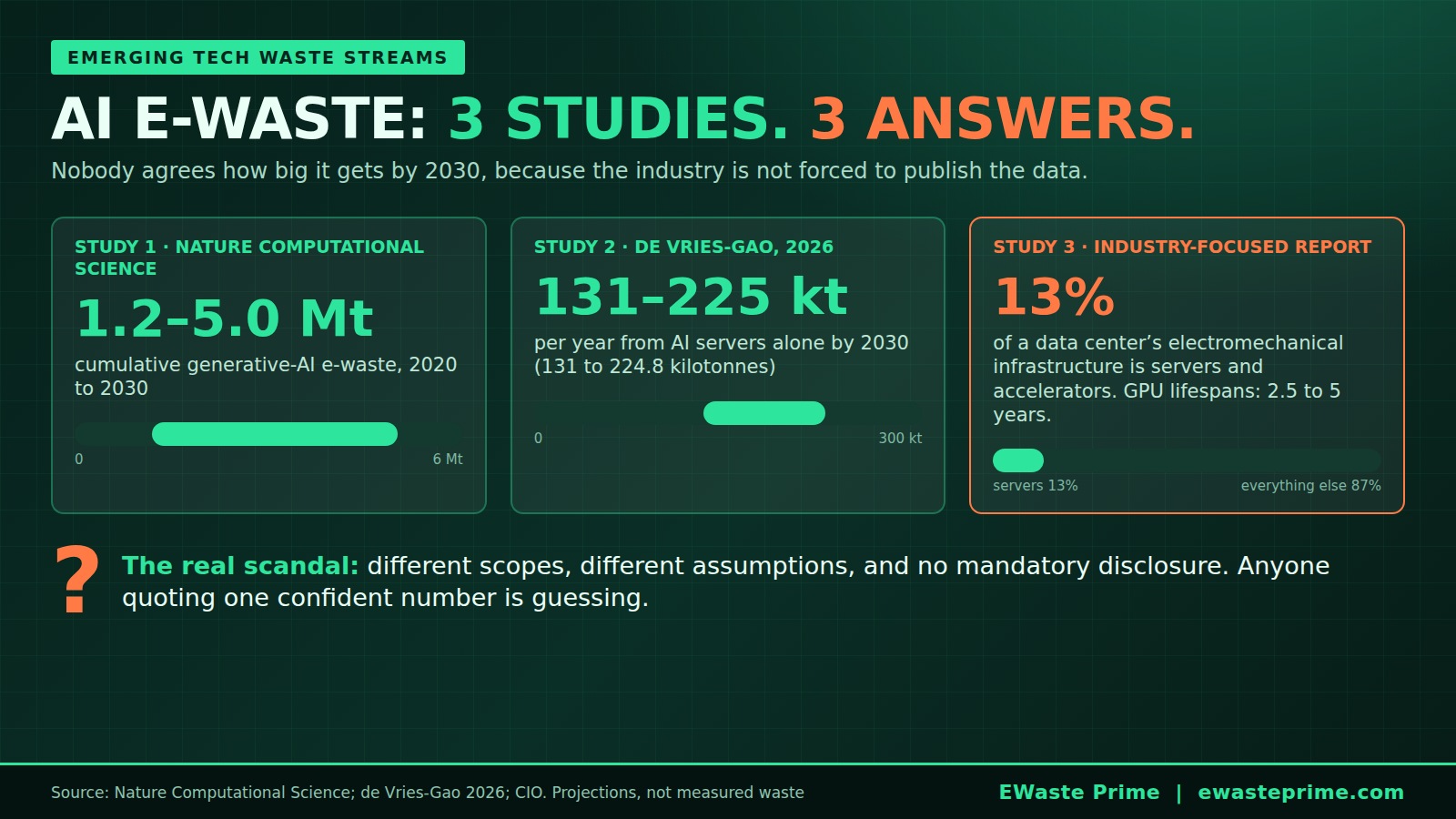
Quick answer: Estimates of AI e-waste vary enormously. A 2026 study projects 131,000 to 224,800 tonnes a year from AI servers by 2030, while earlier modeling put the cumulative total for generative AI at 1.2 to 5.0 million tonnes by 2030.
AI companies talk about intelligence. They rarely talk about what they throw away.
A study in Nature Computational Science projected that generative AI could produce 1.2 to 5.0 million metric tons of e-waste cumulatively by 2030. Then a 2026 study by data scientist Alex de Vries-Gao estimated AI servers alone at 131 to 224.8 kilotonnes per year by 2030, a lower figure than earlier assumptions. A third report argues both miss most of the picture: servers and accelerators are only about 13% of a data center’s electromechanical infrastructure, and rapid GPU turnover is compressing equipment lifespans to roughly 2.5 to 5 years. One expert quoted in coverage of that report called its near-term numbers probably overstated.
Three studies, three very different answers. The gap exists because the industry does not publish reliable data. De Vries-Gao himself warns that without greater transparency the real scale risks being underestimated, and says the companies behind data centers carry responsibility.
Retired data-center hardware is a high-value, data-bearing stream. It needs certified data sanitization and audited recycling before any of it reaches the resale market. Reuse also matters: researchers found that repurposing equipment for lighter workloads could cut AI e-waste substantially.
These are modeled projections, not measurements of waste already generated. Anyone quoting a single confident number is guessing.
How much e-waste will AI create by 2030?
Credible estimates range from roughly 131,000 tonnes a year for AI servers alone to millions of tonnes cumulatively, depending on assumptions.
Why do the estimates differ?
They use different assumptions about server lifespan, hardware supply and which equipment is counted.
What should happen to retired AI hardware?
Certified data sanitization, then reuse where possible and audited recycling.
Share This News